A constant source of love and support.
Thursday, January 22, 2015
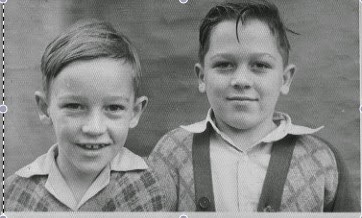
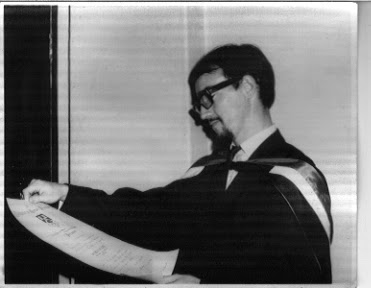
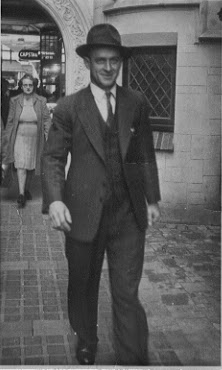
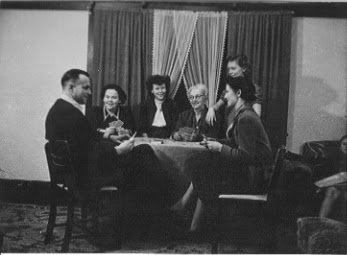
Posting the photos mentioned in the book...
A constant source of love and support.
Thursday, October 2, 2014
Next appearances to spruik the book ...
It begins at 4 pm. (Books will be available for sale.)
| 30 Maple St, Maleny QLD 4552 Wednesday 15th October, I'll be doing something similar - this time with live music, courtesy of peerless songbird Sarah Buchanan - at the Brunswick Heads Public Library... ... Fingal St, Brunswick Heads, NSW 2483 It begins at 6 pm. (Books will be available for sale.) |
Tuesday, September 2, 2014
Brisbane Writers Festival
I will be discussing The Boy in the Yellow Dress during a panel on MASCULINITIES during the Brisbane Writers' Festival, Sunday 7th September. 1pm. State Library of Queensland, Kuril Dhagun Room.
The State Library is located on the riverfront in Peel Street, South Brisbane.
MAN UP
Friday, July 25, 2014
Marvellous gathering in Singapore
The event was staged by the Asia Pacific Writers and Translators Association, which meets each year in a different Asian capital. Hence, the participants came from many of the countries I used to visit when teaching meditation on behalf of my beloved guru, three decades ago.
This was quite fitting, as The Boy in the Yellow Dress is so largely concerned with the encounter of the naive boy from Perth (namely, moi!) with people from different cultures, virtually 'carrying coals to Newcastle' as the old saying goes, by presuming to 'teach' meditation to people in Asia !
Many of the events were housed in the former Parliament House of Singapore, now re-purposed as 'Arts House' and run by a dynamic team who, along with the Book Development Council of Singapore, did so much to make our gathering so welcome (and so well-fed!)The chamber in which we sat used to house the first generation of Singapore government members, one of whom, Lee Kwan Yew, steered the new city/state through its early years as a powerful, almost autocratic, Prime Minister. He is still an MP (at around 90 years of age), and his son is the current Prime Minister.
A city/state of wonderful cultural diversity, somehow Singapore has melded its different component parts into a dynamic and prosperous
international hub, but its reputation as a nation hospitable to international visitors was put to the test just as our conference was about to begin when the National Library Board, with the approval of the Minister for Communication and Culture, withdrew a number of books written for children from its shelves
Censorship is virtual death for an author, and the books in question, which apparently represented the tip of the iceberg, revealed this quiet practice of removing books as unsuitable when lobbied by small interest groups (in this case some members of a tiny Christian group). The children's books in question included a story about two male penguins in the New York Zoo who raised a chick! This and another two books depicting diverse family arrangements were deemed unrepresentative of the normative model favoured by the powers-that-be in Singapore, who threatened to 'pulp' the books in question.
As the author of a book about a boy who liked to wear a dress (!) I was a trifle nervous at the prospect of arrest, so I declined to bring copies of my book through Customs, as I was unsure of the political situation. As the days passed and the controversy continued, other instances of the covert censorship practices came to light, incluidng a missing copy of an 'Archie' comment with a gay character which had been blocked from importation.
Hence, I was delighted to discover that a consortium of local writers rose in protest over the quiet exercise of censorship and stood up to this covert operation, to great effect. The Starits Times newspaper carried daily coverage of the controversy:
http://www.straitstimes.com/news/singapore/more-singapore-stories/story/100-local-overseas-writers-stand-against-prejudice-liter#sthash.WtENxjVe.L3jqUnJj.gbpl
Even before our gathering came to a close, the books were restored to the stacks (although moved to the 'adults only' section), and the director of the Library declared at a news conference that their deliberations would be more transparent in future.
Here's the marvellous spokeswoman for writers, the novelist Suchen Lim, giving a rousing keynote address on the issue.
"In removing and pulping those books on various family structures, the National Library Board is telling these children that they and their families don't count. In removing these books, NLB is reducing such children and their families into invisibility," she said.
Sunday, June 8, 2014
Getting your hands on a copy ...
Although proper protocol requires that a book may only be 'launched' once, further launch-type events are scheduled in Brisbane, Queensland, Fri. 13th June (at The Avid Reader Bookshop in West End) and in Sydney, at Gleebooks in Glebe, on Sun. 6th July.
The boy in the yellow dress is officially launched!
Next, we travelled north to Byron Bay in New South Wales, where the bookseller sold out of copies of the book! We were graciously hosted by the Northern Rivers Writers' Centre, which stages the annual Byron Bay Writers' Festival where the boy in the frock will be making an appearance in early August ...
The joint was jam-packed with book lovers!
Obviously, I was please with the attention of the resident throng!
But I was thankfully kept from floating off in clouds of self-admiration by the wise counsel of the Mistress of Ceremonies for the evening, the incomparable Lilith Rocha!
Thursday, April 10, 2014
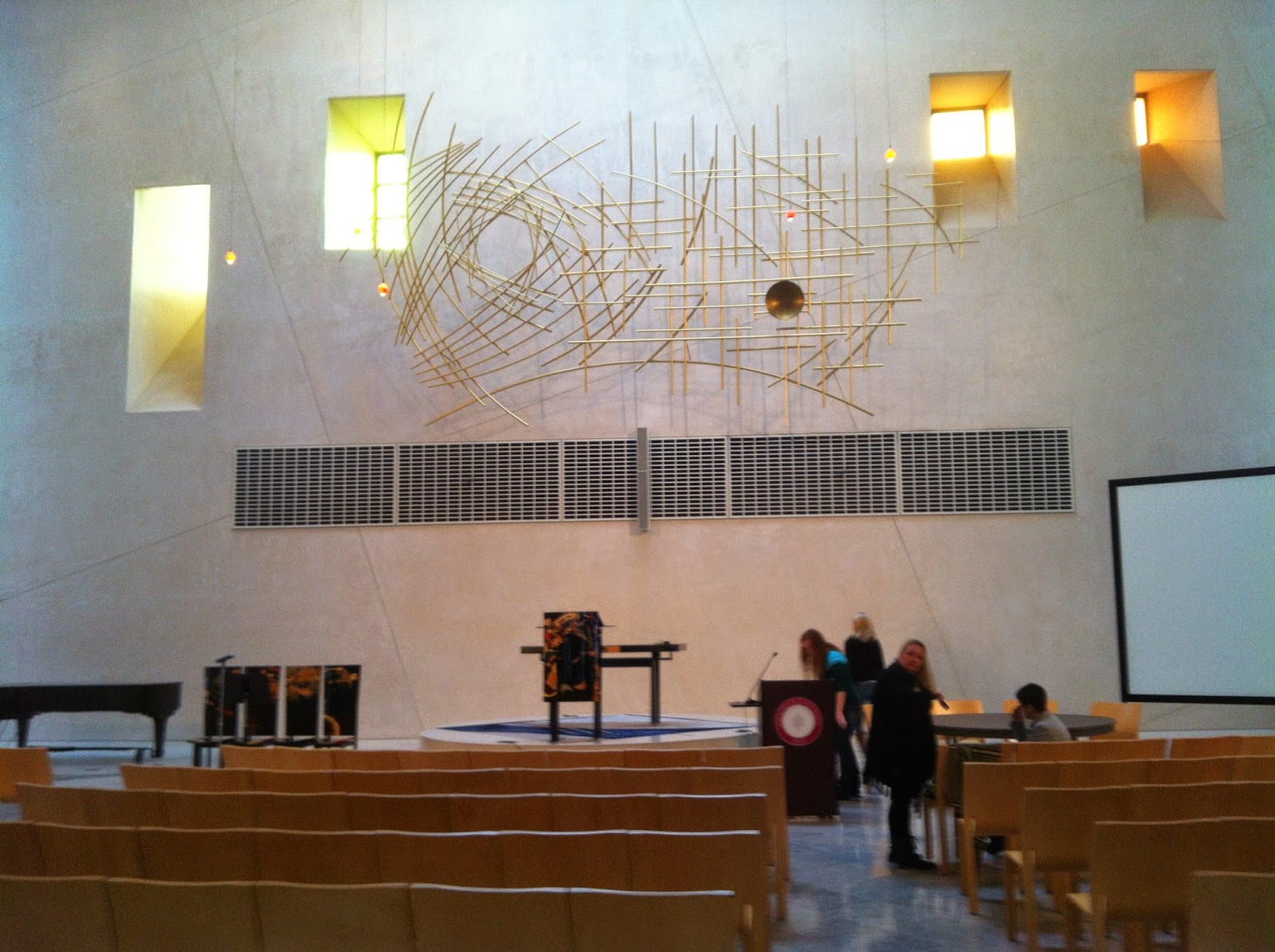
The conference was staged in the Wallace All Faiths Chapel on campus, which is a brilliantly designed setting, studded with marvellous craft and artworks all about that contributed a beautiful aesthetic pleasure to add to the high-level sharing during proceedings:
My paper, "Who's that, telling my story?" was a discussion of the strategies provided by various forms of life-writing (memoir, autobiography, etc.,) that enable you to take charge of the narrative of your own life, and re-position your identity in a more life-enhancing frame than that provided by toxic, conventional religious stories.
I was also able to incorporate themes raised by my previous book on Christopher Isherwood, Mr Isherwood Changes Trains: Christopher Isherwood and the search for the 'home-self', which came out in 2010.
Isherwood lived more than half his life in Southern California.
His life partner, the brilliant portraitist Don Bachardy, provided this portrait for the cover of the book, and the publisher liked it so much he refused to cover it with any print text.
Unfortunately, people ordering through amazon.com, which issues the book as a Print on Demand, don't get that 'cleanskin' version, as amazon refused to allow a cover without text!
A rather poor shot of the interior unfortunately, taken on my allegedly 'smart' phone:
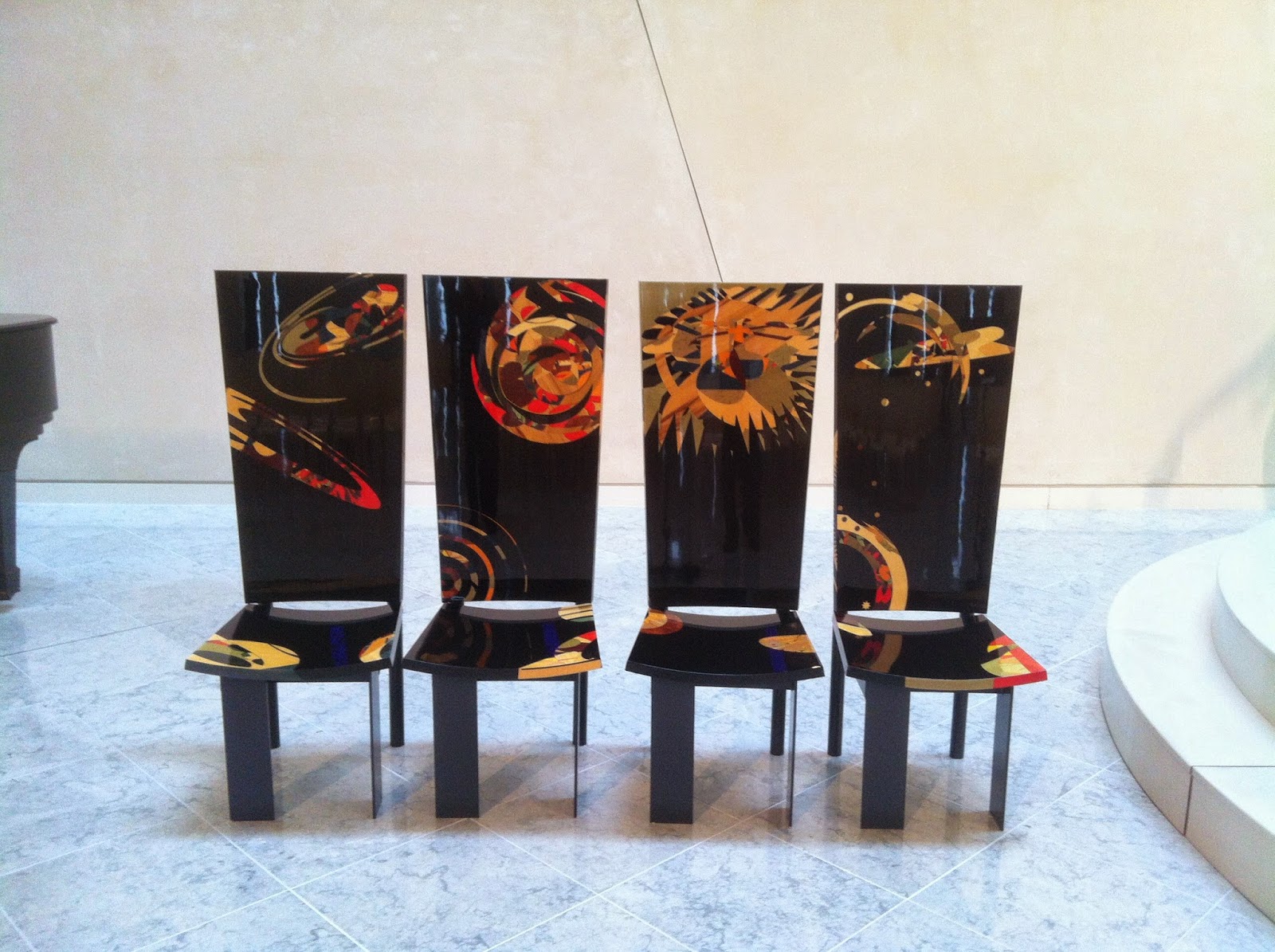
Beautiful artworks within the Chapel include these beautiful lacquerware chairs, with imagery inspired by the Hubble Space Telescope!
We're nearing the starting gate...
This was my favourite:
Thursday, March 21, 2013
slowly, slowly...
'Not commercial enough' is a typical response; 'The writing is good, but it's not the kind of thing we handle' another, this time from a leading literary agent.
But each time it comes back I get the chance to take a long hard look at the writing and, grateful for another chance to tweak the prose, happily throw out the dead wood. I remember early on, when I first managed to get the words down, they were too precious (retrieved, as they were, from the yawning void) to be tinkered with. Precious prose. My own 'holy writ', for God's sake!
But it takes time away, doing other things, to come back to it with more detachment each time, and feel for myself where the lumps are, where there are too many words, where the sentences strangle and meanings dangle...
You know, the inner ear can hear what's meant to be there, and what is dross.
There's the story of the sculptor (was it Leonardo? or Michelangelo?) who said he could see the horse in the block of marble and all he had to do was take away what wasn't the horse.
So I continue, chipping away, each rejection less disappointing.
Thursday, February 4, 2010
falling apart
I've often said that sustained spiritual practice is like 'unraveling the knitting', as in: my mind keeps stitching me back together with its constant story telling, and the practice keeps undoing all that, to dip me back into ... what? the void? No-thing? That place where, having found it, I can let go utterly of me? You catch my drift? Hence, 'unraveling'.
But that process can shake you down to your roots sometimes (that goes without saying, eh?) I suppose there are noble antecedents to this alternative to keeping it all together, then.
Thanks to Mitch Ditkoff for this lovely reminder from the Chinese sage, Lao-Tsu:
I am a fool, oh yes, I am confused.
Other men are clear and bright.
But I alone am dim and weak.
Other men are sharp and clever,
But I alone am dull and stupid.
Oh, I drift like the waves of the sea,
Without direction, like the restless wind.
Friday, October 16, 2009
The re-union of opposites
If it is somehow inappropriate for me to welcome the emergence of the South African intersex athlete as a wild card disturbing the cosy social and political divisions of gender (which a large number of people seem to require for their ontological security), I must return to the iconography available in the Hindu figure of Ardhanisvara, who is the presiding deity of this blogspot, as an archetype that adroitly manages to reconcile the opposites. In the words of F. Scott Fitzgerald,
“The true test of a first-rate mind is the ability to hold two contradictory ideas at the same time.”
If a force is introduced with the intention to divide what is whole, creating separation and division, it also produces a counterforce, which is the desire for reunion.
I draw your attention to the lovely gesture of greeting used by people in certain Eastern traditions, who press the palms of the hands together – the right and the left meeting equally, with the head bowed – when meeting one another. The bow of the head acknowledges that, beyond the division of self and other, you and me, right and left, male and female, there is an over-arching (or underlying) principle of unity that can contain and resolve the apparent separation.
An apology and an explanation
Insofar as the displeasure stems from a mistake that I am willing to acknowledge, here is what I think my root error was in this posting: to the extent that I was appropriating the experience of this young athlete, whom I do not know, I strayed from authenticity, which can only be based on my own experience, so I unreservedly apologise for that.
But to understand the meaning of my own experience, over many decades now, my understanding has been, unavoidably, also based on observation of phenomena outside myself. Many factors feed into the process of intelligent inquiry, and one learns to recognise and interpret useful information from others' experience, surely, as contributing to that inquiry? However, if one appropriates that experience without incorporating others' feedback, then one blunders, and even age, I am afraid, doesn't protect one from making mistakes.
To come back to my own experience, then, I wonder if you have understood the thread that informs this blogspot. You would be mistaken if you assumed that I am defending or proposing some LGBQT agenda. That has not been my intention, and if you were to presume that is the case, unfortunately, that would put you in the invidious position of ‘othering’ me.
So, if I am not permitted to observe and comment on the disturbance that this event involving Caster Semenya – or, rather, the media construction of Caster Semenya – produces, let me offer what I have understood from my own experience.
I am male, but I have nipples. Is this some flaw in the design? Should I be ashamed that as a man, not only do I have nipples, but that as an ageing man, those nipples now sit on breast tissue that has increased with age?
When I read about the stage of differentiation that produces this either/or bifurcation in the growing foetus, my natural curiosity is concerned with knowing more about the primary state that precedes the split. If biology doesn’t help me in de-coding the meaning of that fascinating (to my mind) possibility, perhaps the Tao Te Ching, of Lao Tse, might. If I remember correctly, he says something like: 'From the nothing comes the one; from the one comes the two; from the two come the thousand forms.'
So, believe it or not, in my personal contemplation of my condition, I have pondered deep and long about the 'one' that preceded the two (and later, how that very one emerges from 'the nothing', and what the qualities of that 'nothing' might be.) The urge to remember union (Carl Jung calls that the 'Unio mystica', if I remember correctly; I think of it more simply as ‘the urge to merge’) can be acted out in the world of relationships as if I am looking for the lost part of self that split off (vide Plato’s famous, if idiosyncratic model). If so, I won’t be happy until I find the partner that completes me.
On the other hand, I might try to recuperate the lost parts of self within my own psyche. If you understand that journey, you might recognise that this young athlete (whose pain I cannot presume to know) represents an icon for recovery for me.
In the incident with the yellow dress, which I recovered from memory only as I started to write my memoir with that name, I recalled something of a natural state of unity.
To enter the world of gender ('boys don’t DO that!') was to lose the easy access to a state of unity that preceded what was for me the painful division of gender. If the state of undifferentiated union was the primary reality, gender was a secondary development, and sexuality a very distant THIRD state.
My history as a sissy boy, then a queer man, has not been about 'sexual preference'; please don’t presume that to be the case. Something deeper was driving me, to recover nothing less than the state of unity. If you don’t understand why, let me give you an analogy: I can’t imagine how a house could be built without a ground floor; trying to construct a dwelling with only a second and third floor would be inherently unstable, wouldn’t it; dangerously so, in fact.
I feel that is the case within the psyche (not for everyone, just in my own personal recovery work; I don’t want to universalise a personal revelation – one that I would urge you to respect as hard won and tested – but it does work symbolically in my personal mythopoesis).
To use ‘ground’, as part of the phrase ‘ground floor’, is significant for me. Paul Tillich, the existential Christian theologian, spoke of the Absolute Ground of Being. Perhaps he was drawing from the ancient Vedic principle of Param Brahman, or even the Tao: the great formless field of consciousness/energy that contains all forms (including little me, with all his personal worries and anxieties!)
I have found, over several decades of practice, that certain techniques of introspection, taught to me by an eminently qualified practitioner who had mastered the practice, have helped me to bring the alienated, separate personal ‘me’ self into alignment with the all-embracing field of unity, and a huge feeling of relief has been the gradual result of that re-union (or ‘yoga’) for me.
The healing has not come through sex, nor political struggle, nor religion (as it is conventionally understood), nor psychology, but by recovering the lost aspect of being that was abandoned as I was forced into the world of duality (‘eating the fruit of the tree of Knowledge of good and evil’, perhaps).
In any case, that re-alignment process – which has not come about overnight – has settled the second and third stories back in contact with the ground floor. That has been a major shift at the root of being, and to the extent that it has been achieved, a huge source of healing; psychologically, ontologically and spiritually. Whew!
I will try to explain that process, and the benefits that accrue, to anyone who sincerely wants to know, but I do not need to seek a stamp of approval from any institution or individual; it is my own private victory.
However, I do like to acknowledge and thank the generous and kind assistance that has come to my aid throughout those many years, in the guise of certain people and certain experiences (both hard and gentle!). Most of all, I acknowledge with the deepest gratitude my guru; my spiritual guide and, in effect, ‘life coach’. Without his intervention when I needed it most, and his continuing guidance, encouragement and support, I would have lost my life and all the opportunities it affords.
So it is that – rather than pushing some ill-conceived rationale for whatever agendas you might have imagined and projected into my comments – that is the deeper context for my comments. If, in commenting on the events surrounding this successful athlete, I have caused offence, I apologise.
Joy for all.
Thursday, October 15, 2009
Beyond doctrines, direct perception
Let go and be happy in the natural state.
Let your complicated life and everyday confusion alone
And out of quietude, doing nothing, watch the nature of mind.
This piece of advice is from the bottom of my heart:
Fully engage in contemplation and understanding is born;
Cherish non-attachment and delusion dissolves;
And forming no agenda at all, reality dawns.
Whatever occurs, whatever it may be, that itself is the key,
And without stopping it or nourishing it, in an even flow,
Freely resting, surrendering to ultimate contemplation,
In naked pristine purity we reach consummation.
- Longchenpa, (a 14th century Tibetan master) Treasury of Natural Perfection
Wednesday, February 11, 2009
Oh, for a peaceful passing
I called Judith my 'sister-in-love', as they were not permitted to marry by the perverse laws of a society that doesn't recognise love, only convention. Even if the 'Law' is incapable of recognising loving unions, we are learning to make a family, consciously, out of the web of loving relationships we weave for ourselves and each other. So much support has been flowing in over the past week; this vibrant woman brought joy to so many lives and her passing has generated much good will.
My sister and I were lucky to be with her at the time of her passing. Although she left very quickly, in a sense, as we sat with her over the ensuing hours we were intuitively drawn into deep meditation and inspired to practise some gentle 'healing' arts to soothe her and help her accept the shutdown of her physical systems.
It seems that it takes time for the soul that is moving on to extricate itself from its longstanding association with the physical form it grew to transport itself through this stage of its journeying. Naturally, we get very attached (!) to the body, and fall into identifying with it as ourselves. So 'death' can be a shock to the 'normal' state of affairs; sometimes people panic as they realise they can no longer get it working; so, to die in an atmosphere of peace and acceptance, feeling the 'rightness' of the process, and allowing it to unfold, naturally, is a great blessing.
Alas, on the other hand, the terrible bushfires in the South (mostly Victoria, at the moment) have meant that many people there have died in a mood of panic and desperation, rather than a cocoon of safety and calm.
I hope that even as a flow of material support - money, clothing, food and blood - goes towards the survivors, a parallel flow of love and healing energy goes towards those whose passing was so traumatic.
Friday, January 23, 2009
Progress?
Doesn't Obama realise how many gays and lesbians worked for his election?
And by invoking the name of Jesus, rather than a generic 'God', how included would all the Jews, Muslims and Buddhists have felt?
A lot of hegemonic majoritarian ignorance in play... Hegemony: the dominator influence - as of a state, region, or group - over another or others.
See Wikipedia definition of hegemony:
"a concept that has been used to describe and explain the dominance of one social group over another, such that the ruling group or 'hegemon' acquires some degree of consent from the subordinate, as opposed to dominance purely by force. It is used broadly to mean any kind of dominance, and narrowly to refer to specifically cultural and non-military dominance..."
"Examples are: the use of institutions to formalize power, the employment of a bureaucracy to make power seem abstract (and, therefore, not attached to any one individual), the inculcation of the populace in the ideals of the hegemonic group through education, advertising, publication, etc., and the mobilization of a police force as well as military personnel to subdue opposition."
This from Daniel Chandler's notes on the term (at the Aberyswyth University, Wales, website:
http://www.aber.ac.uk/media/Documents/marxism/marxism10.html)
Italian Marxist Antonio Gramsci used the term "to denote the predominance of one social class over others; not only political and economic control, but also the ability of the dominant class to project its own way of seeing the world so that those who are subordinated by it accept it as 'common sense' and 'natural'.
To succeed, this involves willing and active consent.
'Common sense', suggests Geoffrey Nowell-Smith, is 'the way a subordinate class lives its subordination' (cited in Alvarado & Boyd-Barrett 1992: 51)."
Hence, although I am not a Marxist, my position is not to just roll over and allow these shit-for-brains leaders to control the terms of public discourse. I'm old-fashioned. I protest!
There are those who thank the Prez. for including the invite gay Episcopalian Bishop V. Gene Robinson to articipate. Where I come from, that's called 'having two bob each way', a metaphor from the betting ring. A less sympathetic reading would use something like, he's fond of 'running with the hares and hunting with the hounds...'
Tuesday, December 23, 2008
Pope found guilty of queer bashing
Pope wants humanity 'saved' from homosexualityReuters report, 23 December 2008
[Photo caption: The Pope is greeted in Sydney by World Youth Day co-ordinator Bishop Anthony Fisher (L) and Cardinal George Pell. Photo: AFP]
Pope Benedict XVI says saving humanity from homosexual or transsexual behaviour is just as important as saving the rainforest from destruction.
"(The Church) should also protect man from the destruction of himself. A sort of ecology of man is needed," the pontiff said in a holiday address to the Curia, the Vatican's central administration.
"The tropical forests do deserve our protection. But man, as a creature, does not deserve any less."
The Catholic Church teaches that while homosexuality is not sinful, homosexual acts are.
It opposes gay marriage and, in October, a leading Vatican official called homosexuality "a deviation, an irregularity, a wound".
The pope said humanity needed to "listen to the language of creation" to understand the intended roles of man and woman.
He compared behaviour beyond traditional heterosexual relations as "a destruction of God's work". He also defended the Church's right to "speak of human nature as man and woman, and ask that this order of creation be respected".
- Reuters
Comment:
Pope Benedict speaks of ‘saving humanity’ and of the duty of the church ‘to protect man from the destruction of himself’, when in fact the vast majority of mankind has already recognised that it is this man - and the cruel and perverse teachings of his increasingly irrelevant church - that we need to be protected from. (If he were to follow his own logic, should he not himself have been breeding all this time, instead of bothering us with his misguided morality-for-others?)
If Ratzinger/Benedict were to really ‘listen to the language of creation’, as he advises, he would have noticed, along with the biologists, that so-called ‘homosexual’ acts have been observed occurring right across the ‘natural’ world, among literally THOUSANDS of species, that in fact, such acts are normal variations of sexual behaviour. (See Bagemihl, Bruce. Biological Exuberance: Animal Homosexuality and Natural Diversity. New York: St. Martin's Press, 1999); (see Bagemihl, Bruce. Biological Exuberance: Animal Homosexuality and Natural Diversity. New York: St. Martin's Press, 1999).
What kind of ‘human nature’ is this man referring to? And when, exactly, did the radical Jesus become co-opted as an apologist for normative bourgeois sexual morality?
Thursday, November 13, 2008
The abstract for the AAR conference
For British critics, Christopher Isherwood went off the literary radar when he declared himself a pacifist and de-camped to California on the eve of WWII. Nothing he wrote after the "Berlin Stories" (1939), when his life was barely half over, until "Christopher and His Kind", in 1976, when he emerged as a kind of gay literary icon, was accorded much serious attention from Britain’s literary establishment.
Furthermore, what he published during his long relationship with a guru in the Ramakrishna Vedanta tradition, which culminated in the classic "My Guru and His Disciple" (1980, published when he was 75), has scarcely been taken seriously, and few literary critics have detected the influence of Vedanta in his later work (e.g. Nagarajan 1972). Yet there have been calls for Isherwood to be re-evaluated as a serious religious writer (Wade 2001).
If such calls are to be taken seriously there are several issues that need to be addressed, not the least of which would be the dominant cultural expectations surrounding the (im)possibility of a spirituality not predicated on the denial of (a non-conformist) sexuality. "My personal approach to Vedanta was, among other things, the approach of a homosexual looking for a religion which will accept him", he wrote in 1970. This panel will interrogate several of the issues contributing to the occlusion of his religious life and writing.
In addition to the pathologizing discourse of psychological medicine that promulgated a construction of "homosexuality" as developmental failure, for example, there is also the problem of an unreconstructed colonialist prejudice towards religious practices associated with a subject people. For a lapsed Anglican atheist and former socialist to take on a guru and investigate Vedanta was unacceptable in 1939, and contributed to the feeling in Britain that he was, once again, "letting down the side". For his best friend, W.H. Auden, all this "heathen mumbo jumbo" was really beyond the pale. Isherwood was seeking out not only a rationale for his new-found pacifism, but a differently ordered array of "technologies of the self" than those provided by the Anglicanism of his upbringing. In Vedanta he found useful transformational tools among an otherwise "subjugated knowledge" system (to borrow Foucault’s terminology) that allowed him to move beyond the boundaries of his culturally ordained subject positioning.
His persistence with the practices of the Ramakrishna Vedanta tradition while continuing as an unrepentant "homosexualist" (Savage, 1979), is an instance of what Judith Butler would describe as a moment "in which the subject exceeds the terms that constitute him/her", a staging of "unforeseen and unsanctioned modes of identity" (Salih, 10).
The panel will address the role of auto/biographical praxis in resignifications of "queer" identity, drawing not only on Butler, but also on feminist theorists of life writing such as Sidonie Smith and Julia Watson (1996), who say that in specific situations, people may "choose not to narrate the stories that are prescribed for them", opting instead to "reframe the present by bringing it into a new alignment of meaning with the past" (12). Writing autobiographically becomes a resistant strategy for re-narrativizing the self, an assertive recontextualization that recovers meaning from the toxic narratives buried within hostile discourses. The "subject" changes place — from being a product of a discourse of subjugation into an assertive agent of self-signification. (One panelist will trace the roots of the genre of "queer spiritual autobiography" back to Whitman and Carpenter in the 19th Century.)
The panel will analyze how his investigation and embrace of Vedanta philosophy and practice confronts the standard views of what is possible for a "gay" man to know. For, by withholding from non-conformists the possibility of an engagement with "the divine", certain strands within conventional Western religious discourse produce what Foucault calls "regimes of truth" — power/knowledge relations that constitute "a set of rules by which truth is produced". In his personal search and his textual interrogation of notions of what constitutes a "self", Isherwood produced versions of subjective identification that disrupted authorized views of masculinity, and confronted the exclusivist modeling of the religious life as it was framed discursively within his own historical and cultural context. One panelist will interrogate modernist constructions common to the period, including the notion that “the homosexual” subject was an identity understood to signify developmental “failure”, in order to mark its difference from a presumably fully-developed, mature “heterosexual” being.
The discussion will draw upon Peter Berger's analysis of the functioning of "plausibility structures" in the sociology of knowledge systems, and the mechanisms by which different sources of knowledge and information are accorded "differential plausibility", with "deviant" views marginalized or excluded. "The threat to the social definitions of reality" writes Berger, with Thomas Luckmann, is neutralized by "assigning an inferior ontological status, and thereby a not-to-be-taken seriously cognitive status, to all definitions existing outside the symbolic universe" (Berger & Luckmann 1966, 133). One panelist will address the prejudicial dichotomizing which casts Western religious practice within a reified "rationalist" discourse, opposed to Hindu beliefs and practices which it characterizes as "superstitious".
Isherwood was inclined less to approach ideas as abstract principles and more as they were embodied in particular people. In Swami Prabhavananda, an exponent of the Ramakrishna Vedanta tradition, Isherwood found a life-long guide, and the narrative of his spiritual journey is the history of a relationship that deepened over forty years. That bond, and the non-dualist elements of Advaita Vedanta that made it a hospitable environment for a former atheist and all-round dissident to explore his spirituality, will be another focus of this discussion.
Chicago conference
As a result of this initiative I have been approached by a professor of religion from Barnard College, at Columbia University, to guest edit a special issue of her journal and I have asked James Berg to work with me on that. The name of her journal is: 'Postscripts: The Journal of Sacred Texts and Contemporary Worlds', an interdisciplinary journal published by Equinox Publishers (UK).
She made this offer on the strength of the blurb I wrote for the AAR conference program... I'll publish that in a separate post...
Cover art coup!
Apart from the Melbourne publisher (Clouds of Magellan) I met with the editorial chief of White Crane while In New York and he is looking at the manuscript now (it's still in rough draft form, after being re-worked so it reads less like a PhD thesis...)